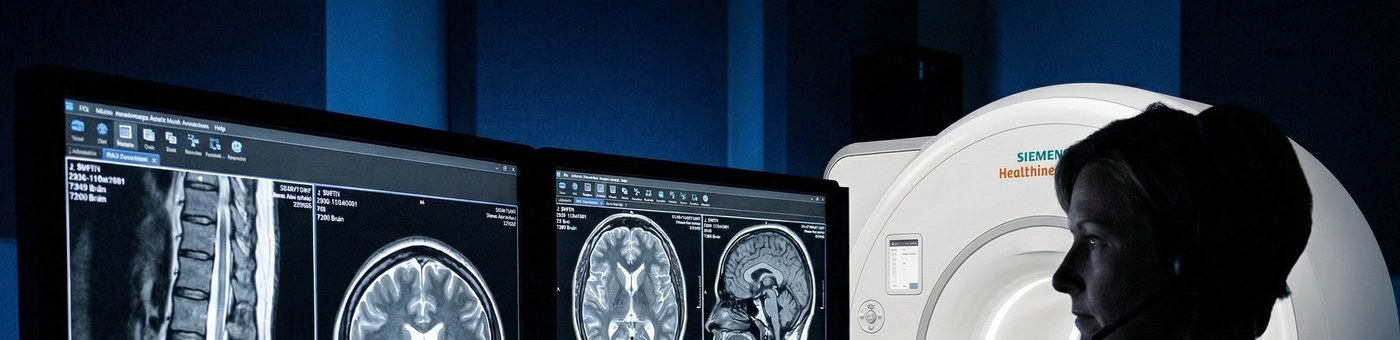
MRI Reading Services
AI-Matched to Your Subspecialty
Subspecialty Coverage Across All MRI Studies
Every MRI study is matched to a fellowship-trained radiologist with the right subspecialty background — not a general reader.
Neuro MRI
Brain MRI, MR angiography, pituitary, internal auditory canals, orbits, cervical/thoracic/lumbar spine MRI, and MR myelography. Our neuroradiologists handle stroke protocols, demyelinating disease, and post-operative spine.
Musculoskeletal MRI
Shoulder, knee, hip, ankle, wrist, elbow, and foot/ankle MRI. Our MSK-trained radiologists provide detailed joint assessments, ligament/tendon evaluation, and cartilage mapping used by orthopedic surgeons to plan procedures.
Body MRI
Abdominal MRI, MRCP, liver MRI with hepatobiliary agents, renal MRI, prostate MRI (PI-RADS), and pelvic MRI. Body fellowship-trained radiologists with subspecialty expertise in oncologic staging and liver lesion characterization.
Cardiac & Breast MRI
Cardiac MRI for function, perfusion, and viability assessment. Breast MRI for screening and staging. These high-acuity studies require dedicated fellowship training — our readers hold those credentials.
AI-Enhanced MRI Reading, by the Numbers
Key metrics across MRI modalities and partner sites
100%
AI pre-analysis on every study
< 1
hr — STAT MRI turnaround target
4
hr — routine MRI turnaround target
6+
Subspecialty coverage areas
Subspecialty MRI Reads
Why Subspecialty MRI Reading Matters
MRI interpretation is the most subspecialty-dependent modality in radiology. A brain MRI read by a general radiologist versus a neuroradiologist produces measurably different reports — in specificity, differential diagnosis quality, and incidental finding management. For imaging centers sending MRI studies to a teleradiology partner, the qualifications of the reading radiologist directly affect clinical outcomes.
At Natoe AI, every MRI study is routed through our subspecialty matching engine before it reaches a radiologist. A knee MRI doesn't go to a neuroradiologist. A brain MRI with suspected MS doesn't go to an MSK reader. This routing happens automatically, based on study type and body part, without any action required from your staff.
AI pre-analysis on MRI runs measurement tools, prior comparison, and anomaly flagging before the radiologist opens the study. This reduces reporting time while maintaining subspecialty-level quality. All reports are final reads, signed by US board-certified radiologists licensed in your state.
Frequently Asked Questions
Does Natoe AI offer subspecialty MRI reads or only general reads?
All MRI reads at Natoe AI are subspecialty reads. Studies are automatically routed to fellowship-trained radiologists by modality — neuro MRI to neuroradiologists, MSK MRI to MSK-trained readers, prostate MRI to body-trained readers with GU subspecialty.
What is the turnaround time for MRI studies?
Routine MRI reads are completed within 4 hours. STAT MRI reads (for urgent clinical scenarios) are completed within 1 hour. Overnight MRI studies queued before midnight are reported by 7 AM.
Can Natoe AI read 3T and 1.5T MRI studies?
Yes. Our radiologists read studies acquired on any field strength, including 3T, 1.5T, and open-bore systems. Study quality is assessed during intake and flagged if technical factors may affect interpretation.
Do you offer prostate MRI (PI-RADS) reads?
Yes. We provide PI-RADS 2.1-compliant prostate MRI reads with structured reporting, zonal mapping, and lesion scoring by body-trained radiologists with GU subspecialty experience.
Are your MRI reads final or preliminary?
All reads are final. Every MRI report is signed by a licensed, board-certified radiologist and carries full medicolegal responsibility. We do not issue preliminary reads.