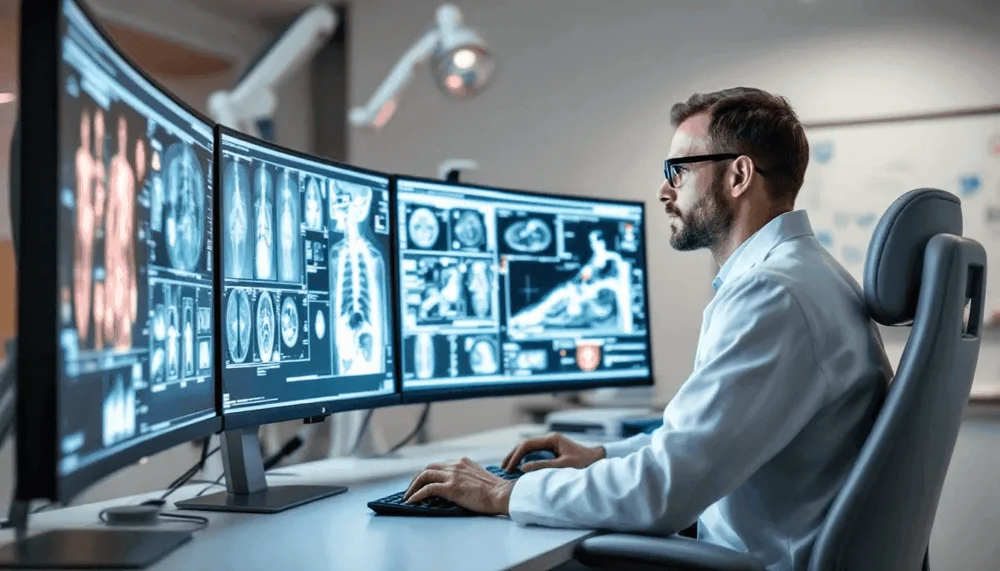
The US radiologist workforce is concentrated in major metropolitan areas. Rural hospitals and imaging centers face a fundamentally different market: few local radiologists, no ability to recruit at competitive salaries, and patients who depend on local imaging rather than driving hours to a city hospital. Teleradiology is not a nice-to-have for rural facilities — it is infrastructure.
The Rural Radiologist Gap by the Numbers
According to HRSA data, rural US counties have roughly one-third the radiologist density of urban counties. In frontier states (Montana, Wyoming, the Dakotas), many counties have zero radiologists within 50 miles. The result: rural patients face delays in imaging interpretation, rural hospitals struggle to offer advanced imaging services, and rural imaging centers operate at a disadvantage they cannot solve with traditional staffing.
What Teleradiology Provides for Rural Facilities
- 24/7 radiologist access regardless of location Geography is irrelevant to teleradiology. A rural imaging center in rural Idaho accesses the same quality of radiologist coverage as a downtown Chicago hospital.
- Subspecialty access without subspecialists Rural facilities cannot recruit neuroradiologists, MSK specialists, or breast imagers. Teleradiology gives rural patients access to subspecialty reads that their local facilities couldn't otherwise provide.
- STAT reads for emergency situations Rural emergency departments depend on rapid imaging interpretation. Teleradiology's STAT protocols ensure that acute stroke, trauma, and emergency cases are read within 15–30 minutes regardless of the time of day.
- No recruitment overhead Rural hospital administrators know how hard it is to recruit physicians to rural communities. Teleradiology eliminates the recruitment problem entirely — coverage is immediate and contractual.
Technical Requirements for Rural Teleradiology
Rural facilities sometimes have concerns about internet connectivity for DICOM transfer. Modern teleradiology platforms handle this well. DICOM compression reduces file sizes significantly, and modern broadband — even in rural areas — is typically sufficient for reliable study transfer. Natoe AI performs a connectivity assessment for all new imaging center partners before go-live to ensure no technical barriers exist.
Reimbursement Considerations for Rural Facilities
Rural Health Clinics (RHCs) and Critical Access Hospitals (CAHs) have specific Medicare billing considerations for teleradiology services. The professional component (PC) is billed separately from the technical component (TC), and teleradiology providers must hold licensure in the state where the patient is located. Natoe AI has experience working with rural health facilities on compliant billing arrangements and can advise on proper claim submission for teleradiology services.